Using ChatGPT and AI for Freelance Writing
Learn how to use ChatGPT and AI writing tools to enhance your freelance writing services.
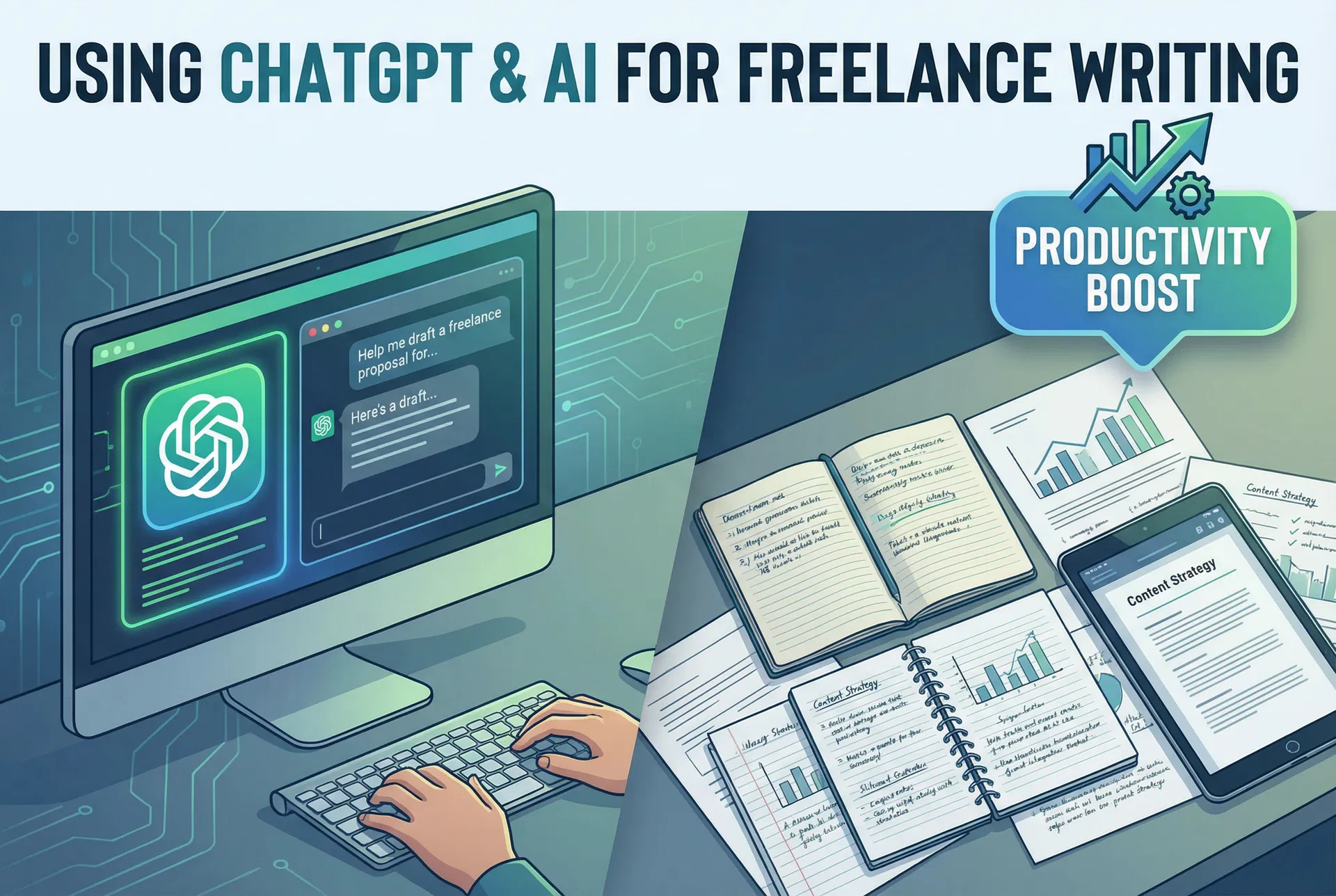
Using ChatGPT and AI for Freelance Writing: A Practical Guide
The Evolving Landscape of Freelance Writing in the AI Era
Generative Artificial Intelligence (AI) and large language models (LLMs) like ChatGPT have rapidly transformed various industries, including freelance writing. While these tools offer unprecedented opportunities for efficiency and innovation, they also present significant challenges and shifts in the market dynamics. Understanding these changes is crucial for freelance writers aiming to adapt and thrive in this new era.
The Impact of AI on Freelance Earnings and Opportunities
The advent of generative AI has introduced a complex dynamic into the freelance market. A study by Brookings [1] revealed that freelancers in occupations highly exposed to generative AI experienced a **2% decline in new monthly contracts** and a **5% drop in total monthly earnings**. This impact was particularly pronounced among experienced freelancers offering higher-priced, higher-quality services. The study suggests that AI tools are leveling the playing field, enabling less experienced or lower-rated freelancers to produce content that approximates the quality of top-tier talent. This can lead to clients being less willing to pay a premium for highly reputable writers, as more affordable alternatives can deliver comparable results.
However, it's not all negative. Some reports indicate that freelancers who effectively integrate AI into their workflows can see **up to 40% higher hourly rates** and save an average of **8 hours per week** [2]. This suggests that while AI may disrupt traditional freelance writing roles, it also creates opportunities for those who adapt and leverage these tools strategically.
The Human Element: Where AI Falls Short
Despite the rapid advancements in AI, there remain critical areas where human writers retain a distinct advantage. AI models, while capable of generating coherent and grammatically correct text, often lack the nuanced understanding of human emotion, cultural context, and genuine creativity. They struggle with injecting personality, unique style, and emotional depth into their writing, which are often crucial for engaging audiences and building brand identity. As Sam Woolfe notes, while ChatGPT can produce succinct and informative content, it "still lacks human creativity, personality, style, emotionality, and ingenuity" [3].
Furthermore, AI-generated content can sometimes be factually inaccurate or prone to generating plausible-sounding but incorrect information, often referred to as "hallucinations." This necessitates rigorous fact-checking and editing by human writers to ensure accuracy and maintain credibility. Google's ongoing efforts to combat AI content spam also underscore the value of high-quality, original content that provides genuine value to readers, rather than generic, AI-generated text.
Leveraging AI Tools to Enhance Your Freelance Writing Business
Rather than viewing AI as a threat, freelance writers can embrace it as a powerful suite of tools to enhance their productivity, streamline workflows, and ultimately deliver better results for clients. The key lies in understanding how to effectively integrate these technologies into existing processes.
ChatGPT: Your AI Assistant for Brainstorming and Drafting
ChatGPT, with its advanced natural language processing capabilities, can serve as an invaluable assistant for various stages of the writing process. It excels at generating ideas, creating outlines, and even drafting initial content. For instance, a freelance writer can use ChatGPT to:
- **Brainstorm blog post topics and angles:** By providing a general theme, ChatGPT can suggest a multitude of creative and SEO-friendly ideas.
- **Develop detailed outlines:** Inputting a topic and desired subheadings can yield a structured outline, saving significant time in the planning phase.
- **Generate initial drafts:** For certain types of content, such as product descriptions or social media updates, ChatGPT can produce a first draft that a human writer can then refine and personalize.
- **Repurpose content:** A blog post can be quickly transformed into a LinkedIn update, a series of tweets, or an email newsletter by prompting ChatGPT to adapt the content for different platforms and audiences.
This allows writers to focus their creative energy on higher-level tasks, such as strategic thinking, injecting unique voice, and ensuring factual accuracy, while offloading more routine or time-consuming aspects to AI.
Beyond ChatGPT: Other AI Tools for Freelancers
The AI landscape extends far beyond ChatGPT, offering a diverse array of tools tailored to specific writing needs. Integrating these specialized AI applications can further boost efficiency and quality:
- **Otter.ai:** This AI-powered transcription service can accurately convert audio interviews or meetings into text, saving hours of manual transcription time for content creators and journalists.
- **Perplexity AI:** Functioning as a conversational search engine, Perplexity can quickly summarize complex topics and provide sources, making research more efficient and comprehensive.
- **Claude Projects:** For structured writing that demands deep reasoning and analysis, Claude can assist in organizing thoughts and generating coherent arguments.
- **Sintra.ai and Surfer SEO:** These tools are invaluable for SEO optimization. Sintra.ai helps in drafting SEO-friendly content and ensuring it aligns with search intent, while Surfer SEO provides keyword suggestions, content gap analysis, and on-page SEO recommendations.
- **Jasper:** A comprehensive AI writing assistant, Jasper can help with various content formats, from blog posts and marketing copy to ad creatives, often providing templates and frameworks to accelerate content creation.
By strategically employing these tools, freelance writers can significantly reduce the time spent on repetitive tasks, allowing them to take on more projects, increase their earning potential, and focus on delivering higher-value services.
Practical Steps for Integrating AI into Your Workflow
Successfully integrating AI into a freelance writing workflow requires a thoughtful approach. Here are actionable steps to consider:
1. **Identify Repetitive Tasks:** Begin by pinpointing tasks that are time-consuming and repetitive, such as initial research, outlining, basic drafting, proofreading for grammatical errors, or generating social media captions. These are prime candidates for AI assistance.
2. **Experiment with Different Tools:** Explore various AI tools to find those that best suit your specific needs and writing style. Many offer free trials or freemium versions, allowing for experimentation without upfront investment.
3. **Develop Effective Prompt Engineering Skills:** The quality of AI output heavily depends on the quality of the input. Learning to craft clear, specific, and detailed prompts for ChatGPT and other AI models is crucial for obtaining relevant and useful results.
4. **Automate Mundane Processes:** Use AI for tasks like proofreading, grammar checks, and enhancing sentence structure. Tools like Grammarly (AI-powered) can catch errors that human eyes might miss, freeing up mental energy for creative refinement.
5. **Leverage AI for Research and Summarization:** Instead of sifting through countless articles, use AI to quickly summarize key information from multiple sources, providing a solid foundation for your content.
6. **Maintain Human Oversight and Editing:** Always remember that AI is a tool, not a replacement. Every piece of AI-generated content must undergo thorough human review, editing, and fact-checking to ensure accuracy, originality, and alignment with the client's brand voice and objectives.
7. **Combine AI with Human Expertise:** The most effective approach is a synergistic one. Use AI to generate raw material or assist with initial stages, then apply your unique human creativity, critical thinking, and industry expertise to elevate the content to a professional standard.
Ethical Considerations and Best Practices
The integration of AI into freelance writing also brings forth important ethical considerations that writers must navigate responsibly.
Transparency with Clients
One of the most critical aspects of using AI in freelance writing is **transparency**. It is essential to be upfront with clients about your use of AI tools in the content creation process. This builds trust and maintains professional integrity. Discuss how AI is being utilized—whether for brainstorming, drafting, or editing—and emphasize the value your human expertise adds to the final product. Many clients are open to AI use, especially if it leads to increased efficiency and quality, but they appreciate honesty.
Maintaining Quality and Originality
While AI can generate content rapidly, the responsibility for its quality and originality ultimately rests with the human writer. This involves:
- **Rigorous Fact-Checking:** Never assume AI-generated information is accurate. Always cross-reference facts, statistics, and claims with authoritative sources.
- **Thorough Editing and Refinement:** AI content often lacks a unique voice or nuanced expression. Human writers must refine the language, inject personality, and ensure the content resonates with the target audience.
- **Avoiding Plagiarism and Generic Content:** Ensure that AI-generated content is not inadvertently plagiarizing existing works. Tools like originality checkers can be helpful, but human judgment is paramount. Focus on transforming AI output into truly original and valuable content.
- **Focusing on Human-Added Value:** Emphasize your unique skills—strategic thinking, creative storytelling, emotional intelligence, and deep industry knowledge—that AI cannot replicate. This is where your true value as a freelance writer lies.
Realistic Expectations and the Future of Freelance Writing
Navigating the AI-augmented landscape of freelance writing requires a grounded perspective, free from exaggerated promises or undue pessimism.
Understanding Earning Potential and Timelines
It is crucial to approach freelance writing with AI with **realistic expectations**. The notion of "get-rich-quick" schemes is a fallacy, and AI tools do not magically eliminate the need for hard work, skill development, and strategic effort. While AI can enhance productivity and potentially increase earning potential, it does so by augmenting human capabilities, not by replacing them entirely. Earning potential will vary significantly based on skill level, niche, client base, and the effective integration of AI tools. Timelines for achieving substantial income remain dependent on consistent effort, continuous learning, and market adaptation.
Adapting and Thriving in an AI-Augmented World
The future of freelance writing is not one where AI replaces human writers, but rather one where human writers who effectively leverage AI will thrive. Adaptation is key. This involves:
- **Developing Complementary Skills:** Focus on skills that complement AI, such as critical thinking, complex problem-solving, strategic content planning, emotional intelligence, and advanced editing. These are areas where human expertise remains indispensable.
- **Specializing in AI-Resistant Niches:** Consider specializing in niches that require a deep human touch, such as highly technical content, creative storytelling, investigative journalism, or content that demands significant empathy and personal experience.
- **Learning to Collaborate with AI:** View AI as a powerful collaborator. Understand its strengths and weaknesses, and learn how to direct it effectively to achieve your writing goals. This partnership approach will be a defining characteristic of successful freelance writers.
Conclusion: Embrace AI as a Partner, Not a Replacement
The rise of ChatGPT and other AI tools marks a pivotal moment for freelance writing. While the initial impact may seem daunting, particularly with shifts in earning potential and job opportunities, the long-term outlook favors those who are willing to adapt and innovate. AI is not merely a tool; it is a transformative force that reshapes the demands on human creativity and skill. By embracing transparency, maintaining unwavering commitment to quality, and continuously developing complementary human skills, freelance writers can harness the power of AI to enhance their craft, increase their efficiency, and secure a prosperous future in an evolving digital landscape. The goal is not to be replaced by AI, but to become an indispensable partner with it, delivering content that is both efficient and profoundly human.
References
[1] Hui, X., Reshef, O. (2024). Is generative AI a job killer? Evidence from the freelance market. *Brookings*. Available at: https://www.brookings.edu/articles/is-generative-ai-a-job-killer-evidence-from-the-freelance-market/
[2] Gandia, E. (2025). How AI can boost freelance writers' revenue: A research report. *LinkedIn*. Available at: https://www.linkedin.com/posts/edgandia_nearly-20-of-freelance-writers-are-using-activity-7374812763023622144-Y3Ju
[3] Woolfe, S. (2024). Freelance Writing in the Age of ChatGPT. *Sam Woolfe*. Available at: https://www.samwoolfe.com/2024/05/freelance-writing-chatgpt.html
Ready to Start?
Explore more resources and guides to help you succeed in your online income journey.
Related Articles
Best Freelancing Platforms for Beginners in 2024
Compare the best freelancing platforms for beginners including Upwork, Fiverr, Freelancer, and PeoplePerHour.

How to Make Money with Content Creation
Monetize your content through blogging, YouTube, social media, and other content platforms.

How AI Tools Can Help You Earn Money Online
Discover how to leverage AI tools to increase your earning potential online.